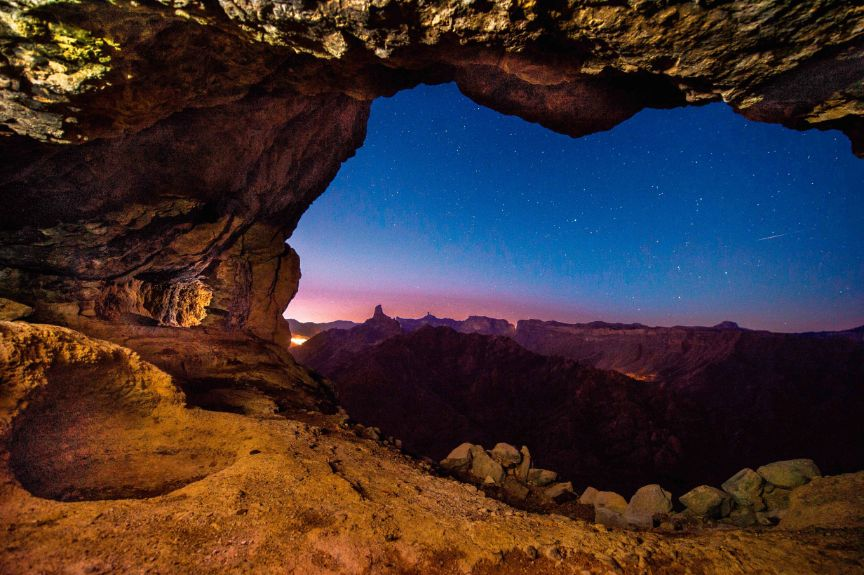
This reserve, special for its typical Canarian vegetation and distinctive ravine terrain, is located in the municipality of La Aldea de San Nicolás. In Güigüi, we find a landscape of immense beauty enriched by flora with some exclusive species and other endangered species. And regarding the area's fauna, many endangered bird species nest here. Continue reading
PLACES WE RECOMMEND YOU VISIT
This wonderful Blue Pool can be reached from the village of El Risco, in Agaete, located on the west coast of Gran Canaria. The waters of the El Risco Ravine descend from the mountains, and once this stream reaches a 20-meter-high drop, it reaches a pool called the Blue Pool. This name comes from the different shades of the pool. Continue reading
It is a site composed of a series of ceremonial, residential, and agricultural-livestock caves. In one of these caves, the curious phenomenon occurs: sunlight penetrates through an upper window, illuminating the western wall in an enigmatic manner, marking the sunrise from the Summer Solstice to the Autumn Solstice, with various engravings. Continue reading
This magical forest is one of the last remaining laurel forests in Gran Canaria, with trees dating back to the Tertiary Era and lush vegetation trails. It is a Protected Natural Area. The reserve encompasses the Los Tilos ravine, the Barranco de los Propios, and the Barranco de el Laurel. We recommend hiking through this magical environment, and for the more athletic, we challenge you to enjoy the... Continue reading
One of the lesser-known treasures of the Canary Islands are these impressive volcanic rock formations, carved by the passage of water over many years. The sheer volume of water that had to flow through these rock formations at that time sculpted the so-called colored tuffs. Learn more: Continue reading